Ambition
Mariners' Museum, Uncurated Search Results
Type: Bugeye
Year: 1883
Builder: T. L. Dawson
Location: St. Michaels

These records are found in the online catalog of The Mariners’ Museum and Park in Newport News, Virginia. Uncurated search results are presented to give researchers and interested readers an idea of whether the museum’s archives contain information about this vessel and whether it may be worthwhile to visit the museum’s catalog search page for further investigation. Uncurated results may be inaccurate or incomplete.
Search mode: Exact Name. Search phrase(s): "Ambition". Results returned: 12. Results displayed in this table: 12.
Use these buttons to send uncurated search results to your own app or text document for further research. First, check the box for any row, or click "Select All" then uncheck any rows. Then click "Show Selections". You can then copy your selections from the text box and past them into your app.
| Fetch? | Row ID | Media | Date | Vessel | Place | Related Places | Inscription/Marks | Subject | Notes | Archive Number |
|---|---|---|---|---|---|---|---|---|---|---|
| 1 | No image URL. | Ambition | P0001.011/01-0167 | |||||||
| 2 | No image URL. | NOTES: In 1917 the British government was looking for ways to develop public support for the War. Wellington House, a government department set up to produce propaganda, published a limited edition portfolio of prints by eighteen artists titled “The Great War: Britain’s Efforts and Ideals”. The prints were to be displayed in galleries around Britain and abroad and sold to raise funds for the war effort. Despite good press coverage, the print sales did not meet expectations and the government lost money on the project. The works were split into two subjects, “Ideals” and “Efforts”. Prints related to “Ideals” expressed the aims and ambitions of the war through use of allegory and symbolism. Nine artists created prints for the “Efforts” portfolios, each producing six images under a single theme. The prints offer a overview of many war activities, including the vital role that many women played. The Mariners’ Museum holds eighteen images by three artists from the “Efforts” portfolio: Muirhead Bone-Building Ships; Frank Brangwyn-Making Sailors; and Charles Pears-Transport by Sea. | CL13177 | |||||||
| 3 | No image URL. | Antarctica–Discovery and exploration.; South Pole–Discovery and exploration | Adrenaline classics | Previous ed. published: Scott's men. London : Allen Lane, 1977. | LB87934 | |||||
| 4 | No image URL. | United States. Navy–Officers–Biography. | Admiral George Dewey after Manila Bay : years of ambition, accomplishment, and public obscurity. | LB49933 | ||||||
| 5 |  | 2010 | Chesapeake Bay (Md. and Va.) | Charlie Quade's grandfather and father were both boat carpenters at the renowned Trumpy Yacht Yard in Eastport before becoming commercial hook-and-line fishermen. Quade, born in 1953 in Annapolis, started out as a crabber when he was young, and had been potting for 25 years. He then switched to pound-netting almost a decade ago, but now he’s returned to crabbing. Charlie also taught himself to be a taxidermist; an ambition he’s had since he was a child. He says his own children do not want to work the water, and he believes pollution has irreparably damaged the Bay. | MS0568/-#06 | |||||
| 6 | 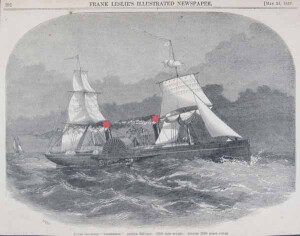 | ADDITIONAL INFORMATION: The Havre Steamship VANDERBILT., While the English people are properly rejoicing over the rapid completion of the GREAT EASTERN, we, good people of the New World, find comfort in the fact, that our wealthy capitalists are also busy adding to our commercial marine. The VANDERBILT, named after the COMMODORE, and built under his direction and for his line, is the finest and largest merchant vessel now afloat. She measures five thousand two hundred and sixty-eight tons, which is twelve hundred and sixty-eight tons larger than the largest line-of-battle ship of the British navy! She is only fifteen feet less in length than the NIAGARA, and but little less is tonnage. We can therefore, at present, as Americans, rejoice in the signal honor of owing the largest man-of-war, and the largest merchant ship in the world. The VANDERBILT is intended to ply between Havre and New York City, and will no doubt become with passengers one of the most popular ships that ever left this port. Upon her trial trip her speed was equal to our best North River boats, and so finely modeled is her bow, that in smooth water she scarcely makes a ripple. It will be remembered that the VANDERBILT visited Washington while Congress was in session, and the "Honorables" visited the ship by invitation of the consumption of immense quantities of champagne and roasted oysters. The VANDERBILT is expected to cross the Atlantic in less time than the Persia has, and consequently proved her self the fastest ocean steamship ever built. Her general appearance is the same as the yacht NORTH STAR. Mr. Vanderbilt although he introduced the walking-beam into ocean steamship machinery, as a general thing, has no ambition to introduce novelties into shipbuilding, his chief design being to improve on what is already known to be excellent. The cabins of the VANDERBILT are plain and substantial; all "modern improvements" to make the passengers comfortable have been introduced with lavish expenditures. The vessel was built by J. Simonson, naval constructor; her length is three hundred and forty feet; breadth of beam fifty-nine feet; depth of hold 33 feet. Her two walking-beam low pressure engines are two thousand horse power, of twelve feet stroke, built at the Allaire works of this city. Diameter of the paddle wheel, forty-two feet, making a circumference much larger than any circus ring men or old men ever saw. | CL17880 | |||||||
| 7 | 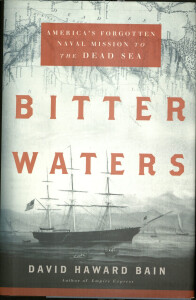 | Dead Sea (Israel and Jordan)–Discovery and exploration–American. | Explorers–Dead Sea (Israel and Jordan). | Bitter Waters : __America's Forgotten Naval Mission to the Dead Sea __David Haward Bain | LB106722 | |||||
| 8 | No image URL. | Terra Nova (Ship); Discovery (Auxiliary screw bark : 1901). | Scientific expeditions–Antarctica. | This collection was donated to the museum by Rear Admiral D. F. Welch, USN, in 1969. It consists of the donation letter from Admiral Welch to Admiral George Dufek, USN (ret.), the Executive Director of The Mariners' Museum at that time, along with two groupings of Antarctic memorabilia. The first is a folio of thirty photographs of Capt. Robert Falcon Scott's final expedition to Antarctica which Admiral Welch received from Capt. G. H. Dennistoun , RN (ret.). Captain Dennistoun's brother James served on that expedition as a dog and mule tender. He is identified as J.R.D. in two of the photos. Also depicted and identified in the folio is Edward "Teddy" R.G.R. Evans. The second grouping consists of fourteen commercially produced postcards depicting Scott's first expedition to the Antarctic. They were given to Admiral Welch by Max Whatman, an editorial writer for the Christchurch (New Zealand) Star. The postcards were produced by the Canterbury Times of New Zealand. | MS0264 | |||||
| 9 | 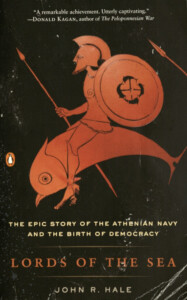 | Athens (Greece)–History, Naval. | Democracy–History. Greece–Athens | Lords of the sea : __the epic story of the Athenian navy and the birth of democracy __John R. Hale. | LB109398 | |||||
| 10 | 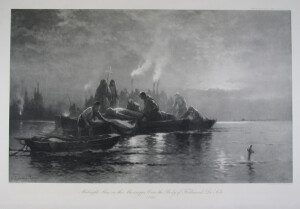 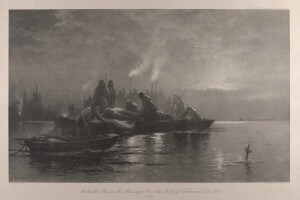 | SHORT DESCRIPTION: Black and white photogravure titled "Midnight Mass on the Mississippi Over the Body of Ferdinand [sic] De Soto (1542)". NOTES: Text from 'Thirteen Chapters of American History Represented by the Edward Moran Series of Thirteen Historical Marine Paintings' by Theodore Sutro, 1905, New York, that accompanies the image: As simple, gloomy and severe as were the circumstances surrounding the departure of the expeditions of Lief Erickson and Columbus, and subsequently of Henry Hudson and the Pilgrim Fathers, so brilliant, hopeful and coveted was the journey of Fernando De Soto, when he set sail from Spain in April, 1538, to conquer Florida and in search of a new Eldorado. Having previously returned from the conquest of Peru, as the chief lieutenant of Francisco Pizarro, possessed of great wealth, and through his marriage with the beautiful Isabella Bobadilla affiliated with the highest nobility, and having been appointed Governor of Cuba by Charles V.—the flower of the Spanish and Portuguese aristocracy flocked to his standard. The seven large and three small ships, including his flag-ship, the "San Christoval," in which the expedition set sail, were fitted out with great splendor. De Soto was then forty-two years of age, having been born at Xeres, Spain, in 1496, while his followers were mostly young men, and a more gorgeous or joyous company cannot be imagined. With them went the wife of De Soto and many other beautiful women, and the voyage was one round of pleasure and festivities. After landing and wintering in Cuba he started from there in May, 1539, with a following of one thousand men in nine ships, leaving the administration of Cuba in the hands of his wife and the Lieutenant-Governor. The original splendor was preserved, the leaders being clad in gorgeous armor and, followed by a host of servants and priests, they took with them all manner of live stock, cattle, horses, mules, etc., and were provided with all sorts of weapons and trappings, but also, significantly, with blood-hounds, handcuffs and iron neck-collars. Thus they landed in Florida, in the neighborhood of Tampa Bay, and began their march northward in the month of June, 1539, the cavaliers to the number of one hundred and thirteen on horseback, and the rest on foot. They passed the winter near the present Georgia border, and in the spring of 1540 reached the location of the present city of Savannah. Instead of pacifying, they alienated the natives through many acts of hostility, in the exuberance of their youth and prowess, in consequence of which many members of the expedition were killed in battle and others died through sickness and deprivation. Nevertheless, they pushed on still further westward towards the Rocky Mountains, and in May, 1541, discovered and crossed the Mississippi River near Lower Chickasaw Bluff, a little north of the thirty-fourth parallel of latitude, in Tunica County, in what is now the State of Mississippi. On again reaching the Mississippi on the return march, De Soto, in consequence of the exposure and hardships to which he had been subjected, sank down with a fever from which he died on May 21, 1542. Owing to the awe which he had inspired in the minds of the natives it was deemed wise by the remnant of his followers to conceal the fact of his death. Accordingly at the dead of night he was wrapped in a flag, in which sand had been sown, and taken in a boat to the middle of the river, and amid the glare of torches, the chanting by the priests of the midnight mass, and his sorrowing and silent companions, solemnly consigned to the depths of the great river. It is this solemn moment which the artist has caught in the painting bearing the above title. As in all the other pictures he has, also in this, depicted all the important details of the occasion without descending to such minute particularity that the painting would lose its poetic character. The sad scene recalls vividly to the mind—in contrast with the high hope and magnificent display of the expedition at its start—the futility of human ambition. The tone of the picture is heightened through the mingling of the pale moonlight with the lurid reflection from the torches, and the coloring altogether is such that it is in perfect harmony with the occasion. It is unnecessary to dwell upon the subsequent fate of the remnant of the expedition, except, perhaps, to say that the picture itself gains in interest by contemplating that, after wandering through the pathless forests, wading swamps, swimming rivers and fighting Indians all the time, and deprived of their leader, and after four years of hardships from the time that the expedition set out, those who were left made their way to Mexico. In the meantime the beautiful wife of De Soto had died brokenhearted, and never was there, all in all, a more tragic ending to an expedition commenced amid so much pomp and glory and with such sanguine expectations. His longed-for Eldorado was not found, and yet De Soto, not unlike Columbus, gained immortality more surely than if his expectations had been realized; for the Father of Waters, the greatest river in the world, will always be associated with his name, and the acquisition of the vast province of Louisiana by Spain led the way for its subsequent transfer to the United States. It was on April 30, 1803, that through the negotiations conducted by James Monroe and Robert Livingston the Province of Louisiana was purchased for the sum of about $15,000,000 from France, which nation had prior thereto acquired it from Spain. In view of the chapters of history which a contemplation of this picture recalls, it is of particular interest during this year (1904), when through the magnificent Louisiana Purchase Exposition we are celebrating the centennial anniversary of the acquisition by the United States of the vast territory, which before De Soto and his followers the foot of white man had never trod. ADDITIONAL INFORMATION: See "Thirteen Historical Marine Paintings by Sutro, pg. 47. | CL18432 | |||||||
| 11 | 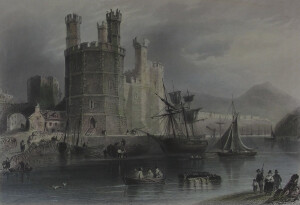 | SHORT DESCRIPTION: The image depicts Caernarfon Castle with people sailing on the River Seiont. A sailing ship and several small boats are beached on the shore during the low tide. In the bottom right corner there is a bit of land showing, with three adults and a child walking. Near them is a rowboat with three people, towing some casks or buoys in the water behind them. The most prominent part of the castle is the Eagle Tower in the center of the image with the three turrets. To the left of that is the Well Tower, and to the left of that is the arched opening in the town wall that at one point had passed over the moat. To the right of the Eagle Tower is the Queen’s Tower. NOTES: The print was published with an incorrect but often used spelling of “Carnarvon.” The name is also misspelled as Caernarvon but the correct spelling is Caernarfon. NOTES: The image is from after page 96 of volume 2 of “The Ports, Harbours, Watering-Places, and Coast Scenery of Great Britain," published by George Virtue in 1842. (TMMP Library DA625 .F49 Rare) The book was first published in 1838 by Charles Tilt with descriptions by William Andrew Chatto. It was then published several times in 1839 and 1842 by George Virtue, and later after 1855 by Virtue & Co. under George’s son, James S. Virtue. The name also changed slightly, but kept the "Ports, Harbours, and Watering Places" part of the title. The books that the Virtues published kept Chatto’s descriptions for the first volume, but they expanded the book to two volumes. William Beattie wrote the text for the new second volume and an appendix added to the end of the volume 1. NOTES: From the end of the 1842 edition of Volume 2: “In taking leave of these two Volumes, illustrating the Ports, Harbours, Watering-places, and Coast Scenery of Great Britain, a few words of explanation appear necessary. The work was originally commenced by Messrs. Finden [William and Edward], and for some time carried on with all the taste and spirit characteristic of these distinguished Artists. But the remuneration accruing from the sale being found inadequate to defray the expenses incurred in its production, it was offered to the present Publisher, who readily saw the improvements of which it was susceptible and became the purchaser. Arrangements were then made for its continuation. Mr. BARTLETT, whose illustrations are so familiarly and favourably known to the Public, set out on a tour of observation along the northern coasts of England and Scotland; and, after visiting every locality indicated, returned with a portfolio of drawings taken on the spot. These were immediately placed in the hands of eminent engravers; a re-issue and continuation of the work were announced; and it is gratifying to state, that the reception which it has since met with from the Public has been most liberal. With regard to the letterpress descriptions, I beg it to be expressly understood that the labours of my pen have been confined to the Second Volume and the Appendix of Vol. 1. The First Volume was written under the signature W.A.C. - prior to my connexion with the work; and, in justice to that author, I feel it at once a duty and a pleasure to conclude the work with this statement. William Beattie, M.D.” January 1842 J. Rickerby, printer, Sherbourn Lane NOTES: Caernarfon Castle was built by Edward I with James of St. George as architect. The construction lasted for 47 years, from 1283 until 1330. An excerpt from The Ports, Harbours, Watering-Places, and Picturesque Scenery of Great Britain about the print. “Caernarvon [sic] Castle, of which the Engraving annexed presents so faithful and striking resemblance is a subject of no ordinary interest: it generally engrosses the attention of all strangers in these parts, and is, in every sense, one of the noblest specimens of castellated architecture in existence. Like so many others of similar design and execution, this fortress owes its origin to the policy of Edward the First, who built it, according to the contemporary history, by appropriating the revenues of the See of York, then vacant, to the purposes of warlike enterprise and ambition. The town is understood to have arisen under the same auspices. The Castle defends it on the south by means of a narrow, deep moat in front. In its west wall are three circular towers, with two others on either side, and a narrow gate or entrance, over which is placed a bare-headed figure with flowing locks,- the statue of the founder,- holding in his left hand a sword, which he draws with his right hand,- or rather, perhaps, is returning to its scabbard, in allusion to the subjugation of the Welsh,- and a defaced shield under his feet. This gate leads to a narrow, oblong court. At the west end is a polygon, or many sided tower, with three others of hexagonal form above, and eagles sculptured on the battlements, from which it received the name, preserved in the Engraving, of the “ Eagle Tower.” It is a noble structure, having ten sides, and a staircase of three hundred steps to the battlements. In this tower is the birth-chamber of Edward the Second,- the first Prince of Wales,- who nativity, on the 25th of April, 1284, was an humiliating epoch to the spirit of Cambrian Freedom. The room measures only eleven feet by seven, -dimensions little in accordance with the importance attached to that event-, but still in some measure characteristic of the fortunes of the royal heir, who, after an eventful reign, was destined at last to perish by a horrible death in the dungeon-room of Berkley Castle. Adjoining this chamber is a semicircular apartment, traditionally described as the King’s Nursery. The castle and the court which it encloses are very nearly a mile in circumference. From the outside, twelve towers are seen; out of which, as observed in those of Conway Castle, issue several smaller angular turrets, which, relived against the horizon, produce a very picturesque effect. A gateway on the south side of the Castle is called the Queen’s Gate, from the circumstance of Queen Eleanor having entered the fortress through this gate, but a temporary bridge erected for the occasion. Our limits do not permit us to indulge in more minute description of this cast and imposing fortress, which, from the state of repair in which it is still kept, may brave the change of season and the fury of the elements for many generations to come. Externally it is still entire, and challenges the admiration of all who have the least taste for what is sublime and striking in architecture. The castle-walls are still washed by the sea on the north and west, as they formerly were on the south. Founded upon a rock, and occupying so strong a position, it might well have been considered impregnable in the absence of gunpowder. Immense as the structure appears, it is said to have been built within the shore space of twelve months; a fact which would appear incredible, did we not reflect that in those days of bitter vassalage the will of the sovereign was a law that could not be transgressed without certain destruction to the offenders. If work was considered impracticable, or of doubtful accomplishment, all hesitation was removed-all difficulties cancelled- by these expressive words, Le Roi l’a voulu! And under the more than magical influence of this laconic phrase, the “towery fortress” of Caernarvon [sic] may have sprung into sudden existence.” | CL16340 | |||||||
| 12 | 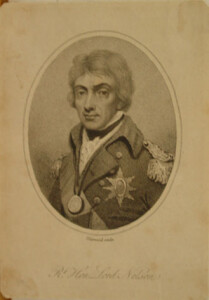 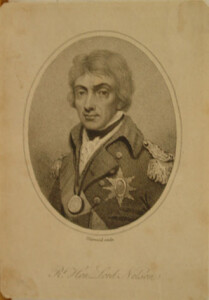 | SHORT DESCRIPTION: Oval portrait, stipple engraving, featuring a bust-view of Horatio Lord Nelson facing slightly left, wearing an undress uniform with the ribbon and star of the Order of the Bath and a single gold medal around his neck. Nelson's right sleeve is empty and hanging by loop from a button on his chest. This image was published in the Universal Magazine of Knowledge and Pleasure, No.24 v.4. November 1805, New Series, page 385. NOTES: Text of article that accompanies the image: A BIOGRAPHICAL SKETCH OF THE LIFE OF THE RT. HONOURABLE VISCOUNT NELSON. WITH A PORTRAIT. Venimus nunc as fortissimum virum, maximique consilii --- Ea que prospere, ei cesserunt non magnitudine copiarum sed consilio quo tum omnes superabat, acciderunt. [Google Translate: We have now the strongest man in the foundation plan --- things are successful, they remain numbers, but by how well all day, actually occurred.] At a time when the best blood in the country is shed for its defiance, it is impossible for the most indefensible of our countrymen to be wholly indifferent to the causes or the measures which have committed us to such hazard. Thus every man, in some degree, is forced, with whatever reluctance, to connect the fate of the individual with the condition of his country. The hero whose name our feeble pen so gladly contributes to immortalize, is no more. He planned, he in great part consummate another splendid victory! But alas! the cypress is so largely entwined with the laurel, that the eye weeps while the heart would fain exult. The mingled sensation is painful in the extreme. The valiant warrior should have survived the moment which is to unseal the fortune or the doom of his country. He has more than once, as by a countermine, blown up the hostile and the insidious operations of those enemies, declared or otherwise, who had taken measures for sapping the very foundations of our greatness: he should have lived to see the perfection of his patriotism, the reward of his devotion, in the end of the troubles which involved his beloved, his grateful country. His ardor and his sacrifice are the more honourable to him as a warrior, because he has never been considered a courtier. Though he even disapproved of an administration, he felt it his duty to struggle to his utmost power for the salvation of his country’s glory. In his expiring eyes might be read the apophthegm of Horace: “Dulce et decorum est pro patria mori” [GoogleTranslate: It is sweet and honorable to die for the fatherland] While the generous combatant this pours out his blood in battle, without allowing himself to enquire into its necessity or expediency, let the governors of the country not forget how great is the responsibility on those who wantonly open the temple of Janus, or unnecessarily delay one hour to shut its gates. The virtue of a senator, and the courage of a soldier, are vainly exerted under and incompotent or a corrupt government. A minister may exultingly display the riches of the country; he undertakes to govern, he may boast of the dominion over those seas, through which that wealth is wafted into his treasuries: for unless his wisdom contribute as much as the sailor or soldier;s sword, to protect what he so highly prizes, he will but awaken envy, create enemy after enemy, and immolate without tnd such magnanimous persons as the one whose loss we have too much reason to deplore. We have a powerful and an inveterate enemy to cope with. He is a furious, and, in many respects, a fortunate emulator of Alexander. He has the ambition of that Grecian, with the disposition of a Nadir Shaw, and an Abdallah, to obtain its gratification; and being a soldier of fortune, like these two latter chiefs, he may be supposed to seek his safety in nearly the same measures, though in different quarters of the globe. It will be in the interest of a civilized plunderer to spare as little as a barbarian plunderer. Agra and Delhi were sacked of more immense treasures than any modern cities contain, tis true, but it was not so much to the advantage of the Eastern conquerors to destroy those thrones, as it would be in a Western, to subvert that of the capital of Britain. It is a folly to estimate the strength of an empire by its riches, rather than by the maxims which are calculated to uphold them. This illustrious Briton was born on the 29th of September, 1758, in the parsonage-house of Burnham Thorpe, in the county of Norfolk. His grandfather was rector of Hillborough, in the same county, where the family had been long resident, and of which living they are, and for many years have been, the patrons. His Lordship’s father [pg 386] the Rev. E. Nelson, married Catherine, daughter of the Rev. Dr. Maurice Suckling, rector of Barsham, in Suffolk, and Woodton, in Norfolk, and one of the prebendaries of Westminster (The Nelsons are, therefore, related to the noble families of Walpone, Cholmondely, and Townshend, his mother bearing the grand-daughter of Sir Charles Turner, bart. of Warham, in the county of Norfolk, and of Mary, daughter of Robert Walpone, esq. of Houghton, and sister to Sir Robert Walpole, first Earl of Orford, and to Horatio, first Lord of Walpole, of Wolerton, whose next sister, Dorothy, was married to Charles Viscount Townshend. The Sucklings have been seated at Woodton, in Norfolk, near three centuries.). By this lady Mr. Nelson has issue eight sons and three daughters, of whom only one son and two daughters are now living; the subject of our memoir was the fourth son. The high school at Norwich possesses the honour of having instilled the first rudiments of education into the mobile mind of this distinguished character, from which school he afterwards removed to that of North Walsham. Captain Suckling, his Lordship’s maternal uncle, was his early and very valuable friend. He was an officer in the sea service, and commanded, first the Raisonnable, of 64 guns, and afterward the Triumph (This gallant officer commanded the Dreadnought, in the West Indies during the month of October, 1757, when, in concert with Captain Forrest, of the Augusta, and Captain Langdon of the Edinburgh, they engaged, off Cape Francois seven French Ships, the of them of the line, one of 50, two of 44, and two of 30 guns. In April, 1775, Captain Suckling succeeded Sir Hugh Palliser as comptroller of the Navy. In 1778, Captain Suckling was elected member of parliament of Portsmouth, but died in July of the same year.). In 1770, he took young Nelson, then only twelve years old, from the above school, and entered him as midshipman on board of his own ship. The subject of altercation, however, with Spain, being adjusted, and the Raisonnable paid off, our young mariner was sent by his uncle on board of a West India ship belonging to the house of Hibbert, Purrier, and Horton, under the care of Mr. John Rathbone, who had formerly been in the king’s service with Captain Suckling, in the Dreadnought. Having returned from this voyage, in July, 1772, Horatio was received by his uncle on board the Triumph, then laying at Chatham. By this voyage to the West Indies, though Mr. Nelson had gained a practical knowledge of seamanship, he had acquired a thorough dislike for the Royal navy, whether from the horror at the contemplation of those scenes of severity at one time, and of excess and vice at another, or whatever might be the cause, certain it is, that it was not without the utmost difficulty Captain Suckling could remove his aversion. This, however, was at length effected, by the firmness and address of his uncle. Among other methods adopted for the accomplishing this desirable end, it was held out to his nephew, that if he attended well to his duty, he should be permitted to go into the cutter, and decked long-boat, attached to the commanding officer’s ship at Chatham: this operated on the mind of the aspiring youth, as was expected, and by its means he became an excellent pilot for vessels of that class, which sailed from Chatham to the Tower of London, and also down to the Swim Channel to the North Foreland. By these short navigation, some of them in most difficult passages, the mind of Nelson acquired that strength and firmness, for which he was so particularly distinguished throughout his subsequent glorious career. A voyage of discovery towards the North Pole having been resolved upon the Race Horse and Carcase, bombs, were ordered in April, 1773, to be fitted out for that purpose; the command of the former was given to the Honourable Captain Constanting John Phipps, afterwards Lord Mulgrave, that of the latter to Skeffington Lutwidge, esq. The object of this voyage was to ascertain the practicability of a North-west passage into the South Seas, or at least to discover how far navigation was possible towards the North Pole, and to make such observations as might contribute to the advancement of the nautical knowledge. Instructions had been given that no boys should be received on board; yet the ardent manner in which young Nelson entreated to be permitted to accompany the expedition, and his officer to become coxswain to Captain [pg 387] Lutwidge, rather than be left behind, struck the commander of the Carcase with such admiration, that he was irresistibly prevailed on to receive him in the above capacity. A friendship of the most generous nature from that moment ever after subsisted between them. The ships sailed from the Nore June 2nd, 1773. In this arduous voyage Nelson greatly distinguished himself, particularly in the beginning of August, when the two vessels were so perilously situated off the Seven Islands, from their becoming suddenly locked in extensive fields of ice (Amidst these dreary scenes, the following circumstance occurred, which shews his wonderful perseverance and cool intrepidity. In these hush northern latitudes, the nights are generally clear: during one of them, notwithstanding the extreme bitterness of the cols, young Nelson was absent from his ship’s company, and every search was instantly made in quest of him, and it was at length the general opinion he was lost; when, as soon as morning dawned, to the astonishment of his messmates, he was discovered at a great distance on the ice, in the act of pursuing an enormous bear with a musket, the lock of which, it seems, being injured, the piece would not go off, and he had therefore pursued the animal in hopes of tiring him, and being enabled to effect his purpose with the butt end! On his return, Captain Lutwidge reprimanded him for leaving the ship without permission and in a severe tone demanded what motive could so possibly induce him to so rash an action? To this the young hero replied with great simplicity --”I wished, Sir, to get the skin for my father.”) for five days, at the end of which, the adventurous navigators were happily freed from the horrid apprehensions of perishing by poplar cold, which, it has been justly observed, appeared too likely to have been realized, as in abandoning their ships, they would have put their safety upon a very precautious contingency. The most northern point of latitude which they reached was 81 deg. 36 min.; when finding utterly impracticable to penetrate any farther, they made for the harbour of Smeerenberg, which lies on the Northwest of Spitsbergen : from this place they shaped their course homeward, and young Nelson returned safe to Orfordness on the 24th of September, having been absent one hundred and fourteen days. A biographer of the late Earl Howe (who, like Nelson, had, at the age of fourteen, shared the perils attendant on a voyage of discovery) says: “Even at this age there was a hardihood and intrepidity about the noble youth that promised much,” but of Nelson we might at this period say, as was of Miltiades, “that his countrymen might now not only hope well of him, but even assure themselves he would be such an one as they found him upon trial.” Scarcely were the two vessels paid off, when our young hero, understanding a squadron was fitting out for the East Indies, exerted his whole interest to be appointed to one of the ships. He has just explored the frigid zone, he was now anxious to pass the torrid; his wishes were gratified. He obtained a birth in the Sea Horse, of 20 guns, commanded by the gallant Captain Farmer (This brave, but unfortunate commander, was afterwards appointed to the Quebec, in which he engaged a French frigate of superior force for upwards of three hours, when, though his ship had taken fire, and he himself was desperately wounded, he would not quit his vessel; in a short time it blew up with a dreadful explosion!). In this ship, Nelson was stationed in the fore top but afterwards he was placed on the quarter deck. Thus we may perceive that this illustrious character did not arrive at those honours which have of late been so liberally bestowed, but by a long series of arduous and probationary services. During the period Mr. Nelson served in the Sea Horse, he visited almost every part of the East Indies, from Bengal to Bussora. He, however, became so seriously indisposed, that Sir Edward Hughes, who highly esteemed him, resolved to send him to England, in the Dolphin, of 20 guns, Captain James Pigot, whose kindness and attention were highly instrumental in preserving that life, which became so dear to his country. On the 24th of September, 1776, the Dolphin being paid off at Woolwich, Mr. Nelson, two days after, received an order from Sir James Douglas, then commanding at [pg. 388] Portsmouth, to act as Lieutenant of the Worcester, of 64 guns, Captain Mark Robinson, who was under sailing orders for Gibraltar, with a convoy; in this he remained until the 2d of April, 1777. The commander, Captain Robinson, placed the greatest confidence in young Nelson, and was often heard to say, that he felt equally easy during the night, when it was Nelson’s watch, as when the oldest officer on board had charge of the ship. Mr. Nelson, at this time had not attained his 19th year. On the 8th of April, 1777, Mr. Nelson soon passed his examination for the rank of lieutenant, and on the ensuing day received his commission as second of the Lowestoffe, of 32 guns, Captain William Locker. He immediately sailed for the Jamaica station. But the active mind of Nelson could not endure that leisure which he found in a stationary ship, and he solicited an appointment to the commander of a schooner, tender to the Lowestoffe. In this little vessel he ran through all the intricate passages of the King’s Islands, on the northern side of Hispaniola, and became a complete and most skilful pilot here. Every minute incident in the life of so great a character, becomes highly interesting. The following anecdote cannot, therefore be considered unimportant, as it shews the intrepidity and ardour for distinction which is so prevalent in the navy. In a strong gale of wind and a heavy sea, the Lowestoffe captured an American letter of marque. THe captain ordered the first lieutenant to take possession of her, which he accordingly attempted without effect, owing to the tremendous sea. Captain Locker then explained, “Have I no officer who can board the prize?” In this the master ran to the gangway, in order to jump into the Boat. Nelson flew and stopped him -- “It is my turn now,” cried he, “if I come back it will be your’s!” How justly has it been said that the energies of Nelson’s mind were ever in proportion to the dangers and difficulties which surrounded him. On the arrival of Rear-Admiral Sir Peter Parker at Jamaica, in 1778, he appointed Lieutenant Nelson third of the Bristol, his flag ship, of which, by rotation, he became the first: indeed he concluded his services in the rank of lieutenant in this ship. On the 8th of December, the command of the Badger brig on this station was given to him. He was shortly ordered to protect the Mosquito shore, and the Bay of Honduras, from the depredations of the American Privateers. This he did so effectually as to gain the admiration and esteem of the settlers, who expressed their sense of his services by a vote of thanks. Whilst Captain Nelson commanded the Badger, his Majesty’s ship Glasgow, Captain T. Lloyd, a few hours after her arrival in Montego Bay, took fire; it was owing to the great exertions and presence of mind of Captain Nelson, that the whole of the crew were saved from perishing in the flames. On the 11th of June, 1779, Captain Nelson obtained his post rank, and was appointed to Hinchinbroke. At this period, Count D’Estaing threatened Jamaica with a numerous fleer and Army. The command of the batteries at Port Royal was entrusted to Captain Nelson. It was a critical and highly important post, being the key to the naval force of the town of Kingston, and to the seat of the government at Spanish Town. In January, 1780, an expedition being resolved on, for the reduction of Fort Juan on the river St. John, in the gulph on Mexico, Captain Nelson was appointed to superintend the naval department, and Major Polson the military. To further the object of this expedition, Captain Nelson quitted his ship, and superintended the transporting the troops in boats, one hundred miles up this river, a river which none but the Spaniards, since the time of the Buccaneers had ever navigated. Major Polson bore ample testimony (to General Dalling) of the exertions of his brave colleague, who, after storming an outpost of the enemy, situated on an island in the river, constructed batteries, and actually fought the Spaniards with their own guns. The object of the expedition was accomplished, but the health of our gallant countryman had, by his great exertions in this climate, become very considerably impaired; and having been appointed to the Janus, of 44 guns, at Jamaica, he took his passage thither in the Victor sloop to join his ship. Sir Peter Parker perceiving the state of his friend, entreated him to retire to his Penn; but finding, notwithstanding every medical assistance, that his health continued to decline rapidly, he was constrained to return to England, which he did in his Majesty’s [pg. 389] ship Lion, commanded by the Hon. William Cornwallis, to whose care and attention Captain Nelson might be said to owe his life. After his arrival, he was eleven weeks at Bath before he recovered the use of his limbs. In August, 1781, he nevertheless assumed the command of the Albemarle, and passed the whole of the winter in the North Seas. In April, 1781, Captain Nelson sailed with a convoy for Newfoundland and Quebec, under the orders of Captain Thos. Pringle. WHilst cruising off Boston, he was chased by three ships of the line and the Isis frigate, and owing to their superior sailing, they were gaining fast upon him: at this moment, Captain Nelson resolved to trust to Providence, and his own experience in pilotage, and run his ship among the shoals of St. George's Banks: The line of battle ships became alarmed, and immediately quitted the pursuit; the frigate, however, continued it, and having approached within little more than gun shot, Captain Nelson prepared to give battle : the enemy on this (perceiving the main-top-sail laid to the mast) thought proper to tack and sheer off. In October, 1782, Captain Nelson sailed from Quebec with a convoy to New York, where he joined Sir Samuel Hood, and afterwards sailed with him to the West Indies, and was actively employed till the peace. Captain Nelson was soon ordered to England, but directed in his way to attend Prince William Henry, on his visit to Havannah. On the last day of July, 1783, the Albemarle was paid off at Portsmouth, and in the ensuing autumn Captain Nelson went to France, where he remained till the spring of 1784, when he took command of the Boreas frigate, of 28 guns, and was ordered to the Leeward Islands. Captain Nelson had under him the Duke of Clarence, who commanded the Pegasus. On this station, a misunderstanding took place between him ans the governors and custom-house officers, on the subject of the right of the Americans to trade with our West India islands. It will be sufficient to observe, that an act of parliament has since confirmed the propriety of Captain Nelson's conduct. On this command he remained till June, 1787, when he sailed for England. In the month of March of this year he was united to Frances Herbert Nesbit, widow of Dr. Nesbit, of the island of Nevis, daughter of William Herbert, esq. senior judge, and niece to Mr. Herbert, president of that island; the bride being given away by Prince WIlliam Henry. By this lady Lord Nelson had no family, but Lady Nelson has a son now living, by Dr. Nesbit. He is a very gallant officer, and served under his father-in-law with great distinction. Captain Nelson retired with his lady to his native place, at Burnham Thorpe; and never, perhaps, was a man better formed for the enjoyment of domestic happiness, possessing the most gentle temper and the most affectionate heart. But duty to his country, and the acquisition of renown, were objects to which he sacrificed every other consideration. In the year 1790, therefore, on the dispute to relative to Nootka Sound, he left his retirement, and offered his services; but his endeavours to get actively employed were ineffectual till the 30th of January, 1793, when Captain Nelson was appointed to the Agamemnon, of 64 guns(Of this ship's company, a great part was raised in the neighborhood of Burnham Thorpe. The general opinion of his conduct and abilities as an officer was such, that gentlemen were desirous to place their sons under his command, and some obtained the favour: among those whom he was obliged was the Rev. Mr. Bolton, his relation, and the Rev. Mr. Hoste, and Witherhead, who were permitted to enter their sons midshipmen on board the Agamemnon. It has been justly observed, if these gentlemen wished to give their sons an insight into their profession, founded upon practice and example, they could not have selected a fitter master.), in a manner which considerably soothed his feelings, indignant as he was at the coolness with which his offers of service had previously been received. He was soon placed under that noble officer, Lord Hood, then appointed to command in the Mediterranean. At Toulon and at Bastia, Captain Nelson greatly distinguished himself. At the siege of Calvi, in July and August, 1794, he behaved with the greatest intrepidity. Here he was unfortunately deprived of the sight of his right eye, by a shot from the enemy's battery striking the upper part of that which he commanded, and [Pg 390] driving sand into his face with prodigious force. It is impossible for us to record all the brilliant exploits of this veteran. Scarcely a gazette appeared , but it contained an account of some service performed, some gallantry displayed, some enterprise undertaken : if ships were to be cut out of harbours, if the hazardous landing of troops was to be effected, Horatio Nelson's name always stood foremost with his brave officers and crew. The nation was not insensible to these exertions; the two houses of parliament voted a resolution of thanks, which was particularly flattering to Captain Nelson's feelings, and shewed the estimation in which his services were held. In October, 1794, Lord Hotham succeeded Lord Hood in the command of the Mediterranean, and honoured Captain Nelson with his greatest confidence. In the actions which took place with the French fleet on the 13th and 14th of March, as also on the 13th of July, 1795, Captain Nelson highly distinguished himself. Admiral Hotham afterwards appointed him to co-operate with Austrian General De VIns, at Vado Bay, on the coast of Genoa. On this service he remained till Admiral Hotham was superseded by Sir John Jervis. In April 1796, the Commander-in-chief so much approved of Captain Nelson's conduct that he was directed to wear a distinguished pendant; and in May he was removed from his favourite old ship, the Agamemnon, to the Captain, of 74 guns: on the 11th of August, a captain was appointed under him. It was a general observation at this time, that before Nelson quitted his old ship, he had not only fairly worn her out (*When the Agamemnon came into dock to be refitted, in October 1796, we are all informed there was not a mast, yard, sail, nor any part of the rigging, but was obliged to be repaired - the whole being cut to pieces with shot; her hull had long been kept together by cabled served round.), but also had exhausted himself and his ship's company. His constitution, like that of the great Turenne, was originally very delicate, but from habits of active service he was enabled to support great fatigue. His Strength was, however, much impaired previous to Lord Hood's returning to England. In December, 1796, Commodore Nelson hoisted his broad flag on board La Minerve frigate, Captain Greorge Cockburne, which ship, with others, were dispatched to Porto Ferrajo, to bring the naval stores lying there to Gibraltar, of which the fleet at that time stood in great need. On the passage, in the night of the 19th of December, the Commodore fell in with two Spanish frigates, one of which he captured, after a hard fought action of three hours. She proved to be La Sabina, of 40 guns and 286 men, Don Jacobo Stuart, captain. On the 12th of February, Commodore Nelson fell in with the whole Spanish fleet, off the mouth of the straits of Gibraltar, through which he passed safe, although chaced by two line of battle ships; he arrived just in time to give the necessary information to Sir John Jervis, who was stationed off Cape St. Vincent. Commodore Nelson shifted his pendant on board his former ship, the Captain, of 74 guns, Ralph W. Miller, esq. commander. Scarcely had the Commodore effected this, when the signal was thrown out for the British fleet to prepare for action: the ships were directed to keep in close order in the night, during the whole of which, the enemy's signal guns were distinctly heard. The morning was dark and hazy: at half-past six the Colloden discovering five sail in the S.W. quarter, the signal for the fleet to prepare for battle was repeated: at eight o’clock the squadron was ordered to form in close order. A few minutes before ten the enemy’s fleet was visible to the whole squadron. The ships first discovered by Culloden, were at this period separated from their main body, which was bearing down in some confusion to join the separated ships from the enemy’s fleet, before the main body could arrive to their assistance; but the admiral afterwards formed the fleet into a line of battle a head as most proper. The signal was then given to pass through the enemy’s line: this bold manoeuvre was quickly executed; the Spanish admiral, who was now to windward with his main body of 18 ships of the line, 9 being [pg 391] ;eeward: these nine, however, made a movement to join the former, by passing through, or to the leeward of the British line. Commodore Nelson being stationed in the rear, immediately perceived their intention; in order to frustrate it, he wore and stood towards the enemy. By this movement the commodore found himself alongside the admiral’s flagship, the Santissima Trinidada, of 126 guns, a ship of four decks, presumed the largest in the world. This did not, however, deter Commodore Nelson from engaging his colossal opponent, although he had to contend not only with her, but with her seconds ahead astern, each of three decks! While maintaining this unequal combat, which excited the admiration of all his friends, who were anxiously flying to his support, the Culloden, Captain Troubridge, and the Blenheim, Captain Frederick, opportunately arrived. The Spanish admiral was staggered at the intrepidity of the British, and perceiving several other English ships fast approaching, he relinquished his hopes of joining his ships to leeward. Commodore Nelson after this became closely engaged with a spanish three decker, bearing an admiral’s flag. Captain Collingwood, in the Excellent, hastened to his relief, but before he could come up, the spaniard’s mizen mast fell overboard, and she got entangled with her second, the San Nicholas, a two decker, of 84 guns. Commodore Nelson had nearly expended the whole of his ammunition; his vessel had lost her fore-top-mast, and received such considerable damage in her sails and rigging, that she was very nearly rendered hors du combat. A most rigorous fire was, however, kept up on the commodore’s new opponent, who was within pistol shot. The commodore;d men now dropped fast, and from the state of his vessel, a further continuance of the contest appeared impossible. Commodore Nelson’s energy was strengthened by his perilous situation; he resolved on a bold and decisive measure, and determined to attempt his opponent sword in hand. The necessary steps being taken, his ship was laid on board the enemy, her spiritsail yard passed over the enemy’s poop, hooking in her mizen shrouds. The word Board! Being given, the officers and seamen destined for this perilous duty, headed by Lieutenant Berry, (together with a detachment of the 69th regiment, commanded by Lieut. Pearson, doing duty as marines on board) passed with rapidity on board the enemy’s ship, and in a few minutes the San Nicholas was in the possession of her intrepid assailants. The commodore’s ardour would not permit him to remain an inactive spectator of this scene; his motto has always been Quo res cunque cadunt unum et commune periculam Una salus ambobus erit. (Whatever fall for one common danger. One safety. - Google Translate) He accompanied the party in this attack, as if by magic influence, passing from the forechains of his own ship into the enemy’s quarter gallery, and thence through the cabin to the quarters deck, where he received the sword from the dying commander, who had been mortally wounded by the boarders. The sword he afterwards presented to the city of Norwich. Scarcely was this hard-earned conquest secured, but a more arduous task presented itself. His former opponent, the San Josef, a three decker, now sorely annoyed with musketry those who had boarded the San Nicholas. Two alternatives only presented themselves - either to quit the prize, or instantly to board the three-decker. Confident in the bravery of his seamen, the commodore was not long in resolving on which step he should take. Directing an additional number of men to be sent from the Captain on board the San Nicholas, the commodore put himself at their head exclaiming - “Westminster Abbey or glorious victory!” Success in a few minutes crowned the enterprise: the Spanish commander prostrated himself before our gallant hero, and delivered up his sword. It has been very properly observed, that in estimating the services of this lamented hero, it is not a single achievement we admire, in which, perhaps, good fortune had at least as great a share as good conduct, but in his life we trace a series of successes, for the greater part planned with as much judgment as spirit. Commodore Nelson shifted his pendant on board Minerve, and from thence to the Irresistible, Captain Mortin, his own ship being incapable of further service till refitted. As some reward for his gallantry, he was invested with the insignia for the order of the [pg 392] Bath, and the gold medal from his Sovereign. And was also presented with the freedom of the city of London. But the most pleasing reward this great man found, was in the universal applause and admiration of his countrymen. In April, 1797, Sir Horatio hoisted his flag as Rear Admiral of the Blue, and was detached to bring down the garrison of Port Ferrajo. On the 27th of May, he shifted his flag to the Theseus, and was appointed to command the inner squadron at the blockade of Cadiz. During this arduous service, his personal courage shone with full lustre. In the attack on the Spanish gun boats, on the 3d of July, 1797, he was boarded in his barge, which contained only ten men and the coxswain, accompanied by Captain Freemantle. Don Miguel Tyreson, who commanded the Spanish gun boats, in a barge rowed by twenty-six oars and thirty men, made a most desperate effort to overpower Sir Horatio and his brave companions. The contest was long doubtful; they fought hand to hand with their swords, eighteen of the Spaniards being killed, the commandant and all the rest being wounded : the rear admiral succeeded in carrying this superior force. Sir John Jervis, in his letter to the admiralty on this subject, says --”Rear Admiral Nelson’s actions speak for themselves; any praise of mine would fall very short of his merit!” Though the enterprise against Santa Cruz did not succeed, his Majesty’s [arms?] acquired great lustre, and greater intrepidity was never shown by both the officers and men. Here it was the gallant officers and men. Here it was the gallant admiral lost his right arm by a cannon shot. The life of Sir Horatio was providentially saved by his son-in-law, Lieutenant Nesbit, on the night of the attack. The admiral received his wound soon after the detachment had landed; and while they were pressing on with the usual ardour of British seamen, the shock caused him to fall to the ground, where for some minutes he was left to himself, until Mr. Nesbit, missing him, had the presence of mind to return; when, after searching in the dark, he at length found his brave father-in-law weltering in his blood, on the ground, with his arm shattered, and himself apparently lifeless. Lieutenant Nesbit immediately applied his neckerchief to the admiral’s arm, to stop the father effusion of blood, and carried him to the beach, where, with the assistance of some sailors, he conveyed him into one of the boats, and put off to the Theseus, under a tremendous, though ill-directed fire. The next day after the rear admiral had lost his arm, he wrote to Lady Nelson, and in narrating the foregoing transactions, says: “I know it will add much to your pleasure, in finding that your son, Josiah, under God’s providence, was instrumental in saving my life.” This same night, at ten o’clock, the admiral’s arm was amputated on board the Theseus: he immediately after began his official letter, and finished it by eleven. On Admiral Nelson’s return to England after this enterprise, it was not till the 13th of December, that the surgeons pronounced him fit for service. On his first appearance at court, his sovereign received him in the most gracious manner, and expressed his regret that the state of his health and mutilated person would doubtless deprive the nation of his future services. Sir Horatio replied, with a dignified emphasis, “May it please your majesty, I can never think that a loss which the performance of my duty has occasioned; and so long as I have a foot to stand on, I will combat for my king and country.” Shortly after the gallant admiral, as some small recompense for having devoted himself hitherto to the service of his country, and as compensation for the hardships and wounds which he had received in that service, had a pension granted to him of one thousand pounds per annum. Previous to the issuing of this grant, a custom required he should state his services to his Majesty. In narrating the services and life of a character of this nature, our readers will not be surprised to hear, that we find it utterly impossible to do justice to his subsequent career, within those limits, we are constrained to observe. We therefore defer, till our next, the completion of our memoir, a delay which our readers will have less reason to regret, as it will enable us to avail ourselves of the information of those, whose feelings are too poignant to allow them to communicate it at this moment. | CL29337 |
Created 2026 by Don Barker, CBMM volunteer, for the Chesapeake Shipbuilding Project. shipbuilding@sailingworkboats.es